Historically Black colleges and universities are uniquely positioned to inspire and support Black Americans in the five critical roles they play in the US economy.
The first higher-education institution for Black Americans in the United States was founded in 1837. Since then, historically Black colleges and universities (HBCUs) have established themselves as anchor institutions in their communities and critical platforms for the education and advancement of students of color. HBCUs confer 17 percent of all bachelor’s degrees awarded to Black students in the United States, have boosted their students into higher-income quintiles and into prominent political positions, and continue to be key sources of talent. And they are doing all of this with endowments that are seven times smaller, on average, than those of non-HBCUs.
HBCUs have an opportunity to accelerate Black economic mobility even more. Recent events have prompted philanthropists and large corporations to donate to and partner with HBCUs. If such attention and funding could be sustained—and increased—HBCUs could help to unlock not only more advancement for Black Americans but also strong economic performance for the United States. In fact, our data show that a strong HBCU network could increase Black worker incomes by around $10 billion in addition to strengthening the economy with $1.2 billion in incremental business profit, $300 million in decreased student-loan debt, and $1 billion in additional consumer expenditures.
As the McKinsey Institute for Black Economic Mobility (BEM) and the McKinsey Global Institute (MGI) found in their recent report, significant economic and human value can be gained when Black Americans, playing critical economic roles as workers, entrepreneurs and business owners, consumers, savers and investors, and residents, are fully engaged in the economy. HBCUs are uniquely positioned to foster such engagement.
In this article, we outline how HBCUs have substantively improved the economic and educational positions of Black Americans and others in the United States. We also consider the impact these institutions could have for individuals who play the critical roles in the economy cited earlier—and the prosperity they could unleash for many communities.
The impact of HBCUs
HBCUs were established in the United States in the early 19th century out of necessity: most US colleges at the time prohibited Black students from attending. And even up to a century after the end of slavery, Black students were still not welcome at many public and private higher-education institutions. Today, more than 100 institutions in the United States identify as HBCUs, with total average annual attendance of around 300,000 students. And they consistently deliver strong outcomes, especially on economic mobility.
Supporting students
HBCUs represent just 3 percent of all higher-education institutions in the United States, but 10 percent of all Black students matriculating through US colleges are enrolled at HBCUs. What’s more, 17 percent of all bachelor’s degrees and 24 percent of all STEM-related bachelor’s degrees earned by Black students in the United States were conveyed by HBCUs, according to a 2019 report. HBCUs also supply more Black applicants to medical schools than non-HBCU institutions. And HBCUs have graduated 40 percent of all Black engineers; 40 percent of all Black US Congress members; 50 percent of all Black lawyers; and 80 percent of all Black judges.
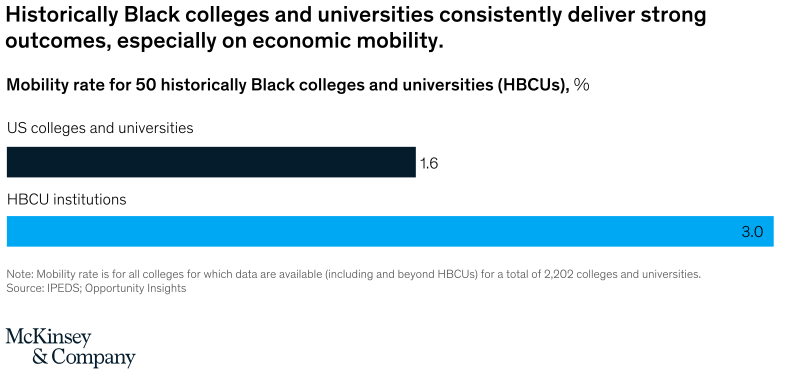
These institutions enroll more than twice as many Pell Grant-eligible (low-income) students as non-HBCU institutions and help create economic mobility for those populations. Graduates of HBCUs are 51 percent more likely to move into a higher-income quintile than graduates of non-HBCUs. The mean mobility rate across all US colleges is 1.6 percent, but the mean mobility rate for HBCUs is 3.0 percent.

In addition to academic and economic outcomes, HBCUs positively contribute to the physical health of their attendees. A recently published study found that Black students who attended an HBCU were less likely to develop risk factors for chronic disease later in life than those who attended predominantly White institutions.
Additionally, Black HBCU graduates are more than twice as likely as Black graduates of non-HBCUs to report having experienced three major support measures while at school—for example, a professor who cared about them as a person; a professor who made them excited about learning; or a mentor who encouraged them to pursue their goals and dreams. The positive effects of such support extend into these graduates’ lives long after graduation: Black HBCU graduates report higher levels of well-being across many areas, including measures of purpose, social well-being, financial well-being, and engagement at work.
Serving the community
Eighty-one percent of HBCUs are located in US counties where the median wage is below the national average. In addition, 65 percent of HBCUs, compared with 47 percent of non-HBCUs, are in geographic areas where past and projected net job growth is slower than average
Without HBCUs, the economic prospects of these communities could be even worse. According to one report, the nation’s HBCUs create 134,090 jobs for their local and regional economies, and every dollar spent by an HBCU and its students generates $1.44 in spending for local economies.
What’s more, there is an “inherent trust” and “cultural sensitivity” built up over time among HBCUs and the neighborhoods and communities in which they operate. HBCUs can leverage this trust to offer much-needed services and programs to their communities, including skills training, food pantries, and medical clinics—and, just recently, COVID-19-related services. For instance, during the pandemic, Alabama State University partnered with state and local officials to provide free COVID-19 testing for public-housing residents in its hometown of Montgomery.
HBCUs: Engines for economic growth
A recent report released by MGI and BEM examines the status of Black Americans, how they are served by public programs, and why addressing any identified gaps could transform lives. We believe HBCUs are uniquely positioned to help fill these gaps—and lift up Black Americans—given their assets, experience, and cultural and historical significance. What follows is an overview of the role HBCUs can play to support Black workers, entrepreneurs and business owners, consumers, savers and investors, and residents. We discuss the actions these institutions can take to accelerate their impact among the students they serve and within the communities in which they operate.
1. Expanding opportunities for Black workers
According to this research, Black Americans in the workforce earn a median annual wage that is approximately 30 percent, or $10,000, lower than that of White workers. More than 60 percent of that gap is driven by less than 4 percent of all occupational categories, with Black workers overrepresented in low-wage jobs and underrepresented in higher-wage jobs. Although Black Americans represent around 13 percent of the total US population, they account for only 5 percent of physicians and 4.5 percent of software developers, for example—but more than 35 percent of all US nursing assistants.
HBCUs can accelerate progress for Black workers primarily by enrolling more students and by graduating a higher share of them. Our research suggests that higher enrollment and retention and graduation rates could translate to an increase in Black worker incomes of $10 billion per year (see sidebar “How we calculated the increased income opportunity for Black American workers”).
Enrollment. Our research points to several potential remedies for increasing enrollment. HBCUs could draw more K–12 students into the college pipeline by partnering with school districts and allowing students to take college courses (and potentially complete an associate’s degree) while in high school. They could also hold summer camps for younger students to build interest and awareness of HBCU programs and opportunities. Additionally, HBCUs could target nontraditional student populations for enrollment. Morehouse College recently announced a discounted online program for people with some college credits. The program aims to serve “more than two million Black men who pursued a higher education [but] never finished their degree,” according to the US Census Bureau.
Retention and graduation rates. Beyond a focus on increasing enrollment, HBCUs could dedicate additional resources toward boosting retention and graduation rates. Many HBCUs have large populations of low-income and first-generation college students who are less likely to stay the course and graduate. Some HBCUs are seeking to improve their support for these students and increase the odds that they will graduate. Dillard University, Howard University, and Morgan State University, for instance, have partnered with the Lumina Foundation on its HBCU Student Success Initiative, in which the institutions collaboratively develop and share best practices for retaining and graduating students, with a particular focus on supporting sophomores.
HBCUs can also ensure that their degree programs are preparing students for high-paying, in-demand careers. For instance, McKinsey’s BEM and MGI research shows that relatively few Black students choose courses of study that could set them on a medical path. HBCUs could provide more career and academic coaching to support students’ awareness of the medical field and what’s required to obtain, say, chemistry or biology degrees. They could also establish new degrees and training programs to develop and support professionals in high-tech fields. For instance, IBM is partnering with 13 HBCUs to build a new Quantum Center that gives students access to IBM quantum computers, as well as educational support and research opportunities. Similarly, tech giants such as Netflix are partnering with HBCUs to offer coding boot camps for students.
HBCUs could also play a role in reskilling and upskilling, especially as increases in automation create additional threats to Black employment. Tennessee State University, for instance, has worked for several years to teach coding and application design to students and adults in the community.
2. Accelerating Black business ownership and entrepreneurship
There is an estimated $1.6 trillion gap in aggregate revenue between Black-owned and non-Black-owned businesses across the US economy—a figure that has only grown over recent decades. McKinsey research shows that there are fewer Black-owned businesses in the United States, and the ones that do exist are smaller than their peers. Black-owned businesses constitute just 2 percent of the nation’s total businesses with multiple employees, and they account for less than 1 percent of US gross revenue. Further, Black-owned businesses have been financially limited by both geography and industry; many are concentrated in the South and in industries like haircare, beauty, and social services, which grow less than 2 percent per year.
Lack of capital is a critical issue for Black-owned businesses. Black entrepreneurs start businesses with roughly a third of the capital of their White counterparts. And more than half of Black business owners state that accessing capital is a constant challenge in scaling their businesses. The lack of capital can also leave existing businesses vulnerable to financial shocks and economic downturn. During the COVID-19 pandemic, for instance, Black-owned businesses closed nearly twice as fast as all other businesses.
What’s more, Black businesses receive a very small percentage of start-up capital: $1 billion of the total $150 billion invested in US start-ups in 2020, or just 0.7 percent. Black women received the smallest share of start-up capital (0.27 percent), and just 4 percent of the entire venture-capital workforce is Black, with 2 to 3 percent in investment decision-making positions.
There is an opportunity, then, for HBCUs to help train and develop the next generation of Black entrepreneurs and to help Black entrepreneurs scale up and sustain businesses in their communities. This could create $5 billion to $12 billion in incremental revenue and $250 million to $1.2 billion in incremental business profits using a 5 to 10 percent estimated profit margin.
HBCUs can continue to encourage entrepreneurship through strong on-campus business programs or by introducing full-degree or certificate programs in entrepreneurship. HBCUs could also work to create partnerships with venture-capital firms to help match students with potential employers, thereby filling their pipelines with high-quality, diverse talent.
Additionally, HBCUs could establish campus accelerator or incubator programs that could offer students funding and investment support, and perhaps even more important, hands-on experience in building a start-up business—all in an academic setting. Some traditional venture-capital firms, including Andreessen Horowitz and SoftBank, have made multimillion dollar pledges to invest in Black entrepreneurs. Such companies could go even further and dedicate money directly to HBCU-housed funds, allowing HBCUs to make investment decisions that would most benefit their communities (see sidebar “Spotlight on HBCUs and entrepreneurship”).
By developing the next generation of Black entrepreneurs, HBCUs can have an outsize impact on equity and diversity.
3. Removing barriers for Black consumers
Black consumers spend over $800 billion every year, but research suggests that nearly $300 billion more could be unlocked if their purchasing experiences weren’t blocked by several factors, including food deserts (regions and communities with limited access to fresh food) and lack of broadband access.
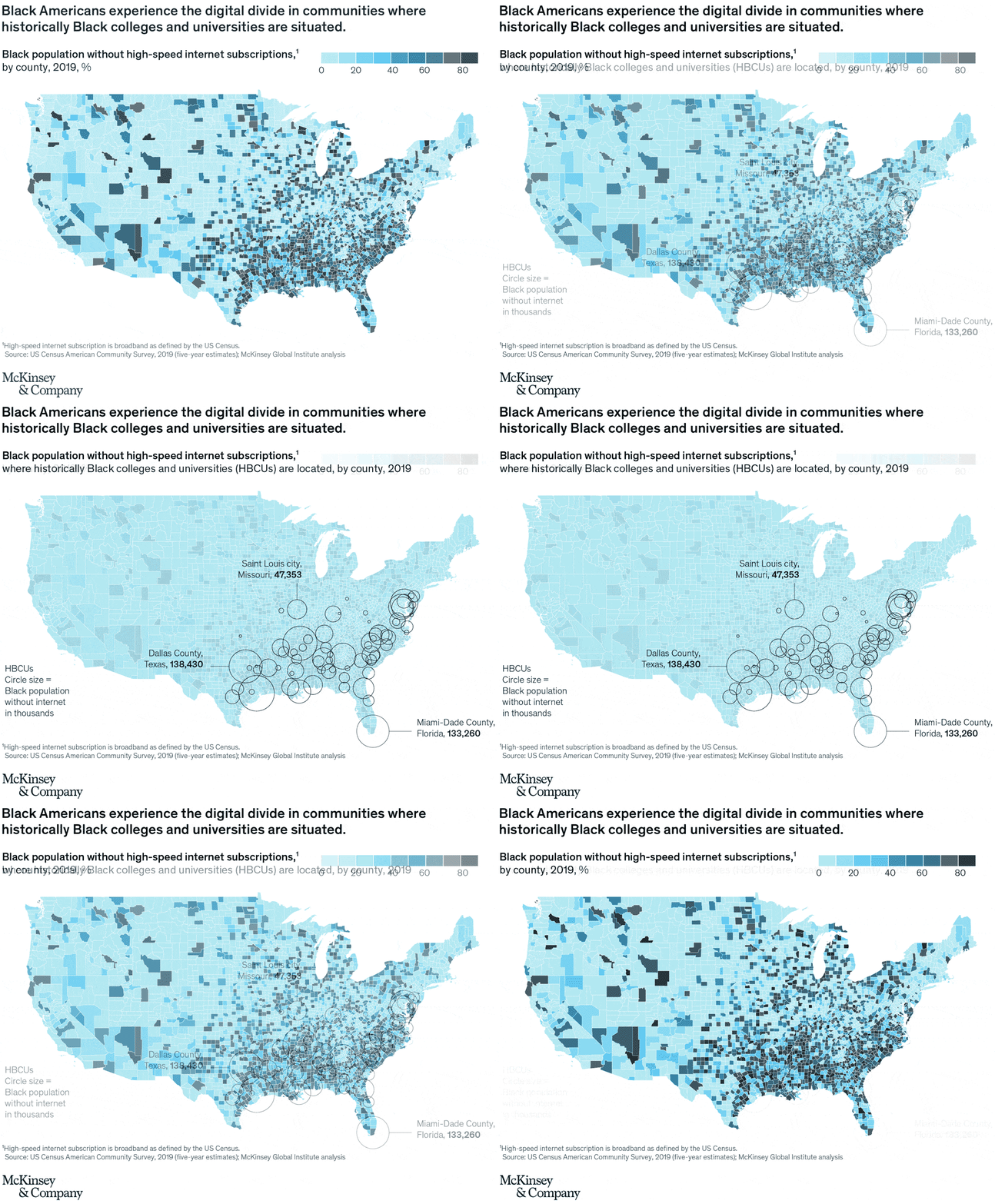
Many HBCUs are situated in areas where Black consumers’ needs are not being met. For instance, 82 percent of HBCUs are in broadband deserts; 50 percent are in food deserts; and 35 percent are in areas without superstores that could offer consumers a full range of groceries, furniture, and clothing. McKinsey research suggests that if HBCUs could share resources with students and communities, an additional $1 billion in additional consumer expenditures could be unleashed (by satisfying the unmet consumer demand in these communities).
For example, HBCUs can establish campus community gardens and consider ways to provide organic produce to food-insecure students and members of the broader community. They can also offer educational programs on the importance of nutrition and fresh food. That is what the University of the District of Columbia has done with its creation of five urban food hubs in various sites across metro Washington, DC. The hubs use production systems that factor in the urban environment, including raised beds for gardens and green roofs and hydroponic and aquaponic growing methods. The hubs provide students and community members with access to fresh food. The initiative has created jobs, improved public health, mitigated water-management problems—and ultimately created a measure of urban resilience in the metro area.
HBCUs could also optimize their existing broadband infrastructures and arrange to give community members affordable access to the network. With greater access to broadband, more people could then take advantage of virtual economic and educational resources that would otherwise be unavailable to them.
To provide more connectivity, HBCUs may need to look for partners. Benedict College is working with the University of South Carolina (USC) to provide open access to eight computer labs across the state of South Carolina, including one on Benedict College’s campus. The labs are located in areas where local school districts, HBCUs, the South Carolina Technical College System, and community members can get to them relatively easily. Benedict College and USC will supply the space, maintenance, and utilities so the labs will be free to users. This effort was funded by a $6 million Governor’s Emergency Education Relief (GEER) fund.
4. Supporting the savings and investments of Black households
The US racial wealth gap is the product of intergenerational transfers, lower incomes, and a lack of financial inclusion. BEM and MGI research shows, for instance, that the median Black household has just one-eighth the wealth of the median White household, with inheritances driving 60 percent of the disparity in annual flows. Smaller paychecks also mean that Black households save $75 billion less annually than White households. Black households are one-third less likely to own their homes, and the median value of those homes is one-third lower than those of White-owned homes.
Additionally, 14 percent of Black adults are unbanked—that is, they are not being served by a bank or similar financial institution. Of unbanked households, 29 percent cited insufficient money to meet minimum-balance requirements as the main reason for not having a bank account, while more than 16 percent said they do not trust banks. Proximity was less of a factor, with just 2.2 percent of respondents citing inconvenient bank locations.
HBCUs can help bolster students’ financial well-being while minimizing postgraduation financial obligations that can inhibit students’ savings and investing potential. Because of the racial wealth gap, a large percentage of HBCU students take out loans, often for large amounts: in 2017, HBCU students took out 32 percent more federal debt per student than non-HBCU students. McKinsey research shows that if the amount of federal debt awarded per year to HBCU students were equal to that awarded to students at peer institutions, HBCU students would accrue $280 million less in loan debt, which would significantly increase their ability to save and invest. To help their students achieve this parity, HBCUs could expand their scholarship offerings and secure more federal grants.
HBCUs also have an opportunity to address banking barriers and help to remove predatory debt traps for students and community members. Because HBCUs are often highly trusted institutions in their communities, they can connect their students and communities with more inclusive financial services—for example, ones without minimum-balance requirements.
Financial well-being, already a common topic at universities, could be an area of focus for HBCUs. They could serve as a knowledge hub for the broader community and offer public seminars on personal investing or cryptocurrencies. The Society for Financial Education and Professional Development has created a student ambassador program that trains students at 15 HBCUs in personal financial concepts so that they can teach others in turn.
And as the financial industry moves away from traditional brick-and-mortar banks and into mobile banking and neobanks—which operate exclusively online—HBCUs have an opportunity to connect their students and communities with innovative financial-management products that may better fit their needs (see sidebar “Spotlight on HBCUs and financial well-being”).
Through carefully selected partnerships and the right learning programs, HBCUs can give students and community members opportunities to increase their savings and wealth, while limiting the risks and concerns Black Americans associate with traditional banking services.
5. Serving Black residents
The quality of education, healthcare, and other essential services varies immensely among communities across the United States, but even more so in Black neighborhoods.
Consider the quality of education: K–12 education is funded through property taxes; thus, the national average for annual instructional spending in public-school districts in which 75 percent or more of the student population is Black is $1,800 less per pupil than in predominantly White school districts. Research shows that although spending per pupil is not the only factor determining educational outcomes, per-student sustained spending does matter.
The situation is even more concerning when it comes to healthcare. Lack of access to healthcare and insurance can have serious consequences, including a racial gap in life expectancy that has widened to five years between White and Black Americans: a McKinsey analysis of 2021 county health rankings shows that if that gap didn’t exist, there might be 2.1 million more Black Americans alive today. Counties where HBCUs are located account for around 500,000 of those lives.
Community services. There are many ways in which HBCUs can help create higher-quality services in their own neighborhoods. For instance, many HBCUs offer teaching degrees in which students are required to fulfill practicums to earn credits. There is an opportunity, then, for HBCUs to place these student teachers where they are needed most within their own communities. Additionally, HBCUs could establish tutoring programs for K–12 students—especially in STEM fields, which have a significant lack of Black representation. HBCUs can also offer their facilities and faculty to run quality summer camps to keep local K–12 students learning and engaged while on summer break (see sidebar “Spotlight on HBCUs serving residents”).
Healthcare. HBCUs can help improve residents’ access to healthcare by attracting and graduating more medical-industry workers. And many HBCUs—especially those offering degrees in medical professions—can offer community clinics that provide health services at little or no cost to neighborhood residents. Meharry Medical College’s Salt Wagon Clinic, a student-run clinic supervised by faculty physicians, provides free, high-quality care to Nashville’s underserved populations and serves as a training ground for Meharry medical students. Meanwhile, in April 2021, four HBCU medical schools in Atlanta, Los Angeles, Nashville, and Washington, DC, received funding to administer more than 100,000 COVID-19 vaccines from mobile units in their local communities.
HBCUs have overperformed—even as they have been underfunded relative to (predominantly White) peer institutions. When compared with institutions with endowments over $1 billion, HBCUs demonstrate a sizable and growing gap in private gifts, grants, and contracts—from more than $100 million on average in 2010 to more than $220 million in 2018.
University endowments are critical for providing stability for institutions (as revenues fluctuate over time); offering student-aid packages; pursuing innovative teaching methods or research initiatives; and enabling longer-term execution of ideas and programs. Between 2018 and 2019, however, the average non-HBCU institution had seven times the endowment value of the average HBCU. In fact, the top ten higher-education institutions on the most recent U.S. News and World Report rankings have 50 times the endowment resources of all the four-year HBCUs combined. What’s more, the average four-year non-HBCU institution has around $1.25 in endowment funding for every $1 in their budget, while the average four-year HBCU only has about 50 cents for every $1. Our analysis shows that if four-year HBCUs had $1.25 in endowment funding for every budget dollar, they would earn an additional $6 billion in endowments. The gap is even larger when viewed through the student lens: four-year HBCUs have around $20,000 in endowment resources for each student, while four-year non-HBCUs have four times that amount per student. If these HBCUs had the same amount of endowment resources as four-year non-HBCUs, they could contribute an additional $17 billion into HBCU endowments for student resources.
Some states are already recognizing and seeking to address the underfunding of HBCUs. Corporations and organizations, too, in the wake of the murder of George Floyd, sought to add or accelerate initiatives to support HBCUs and recruit HBCU students. In fact, 2020 was for some HBCUs their strongest-ever year of fundraising. The opportunity for sustained impact from these institutions is significant. According to our research and calculations, HBCUs have the potential to produce more high-earning graduates, support the development of more entrepreneurs, decrease student debt, and remove barriers for Black consumers. If the current level of attention and funding given to HBCUs can be sustained over time, these institutions can continue the critical work they have been doing since 1837: dramatically improving lives and livelihoods and advancing economic mobility for Black Americans.