FocusQuest®

Categories
For School For Students

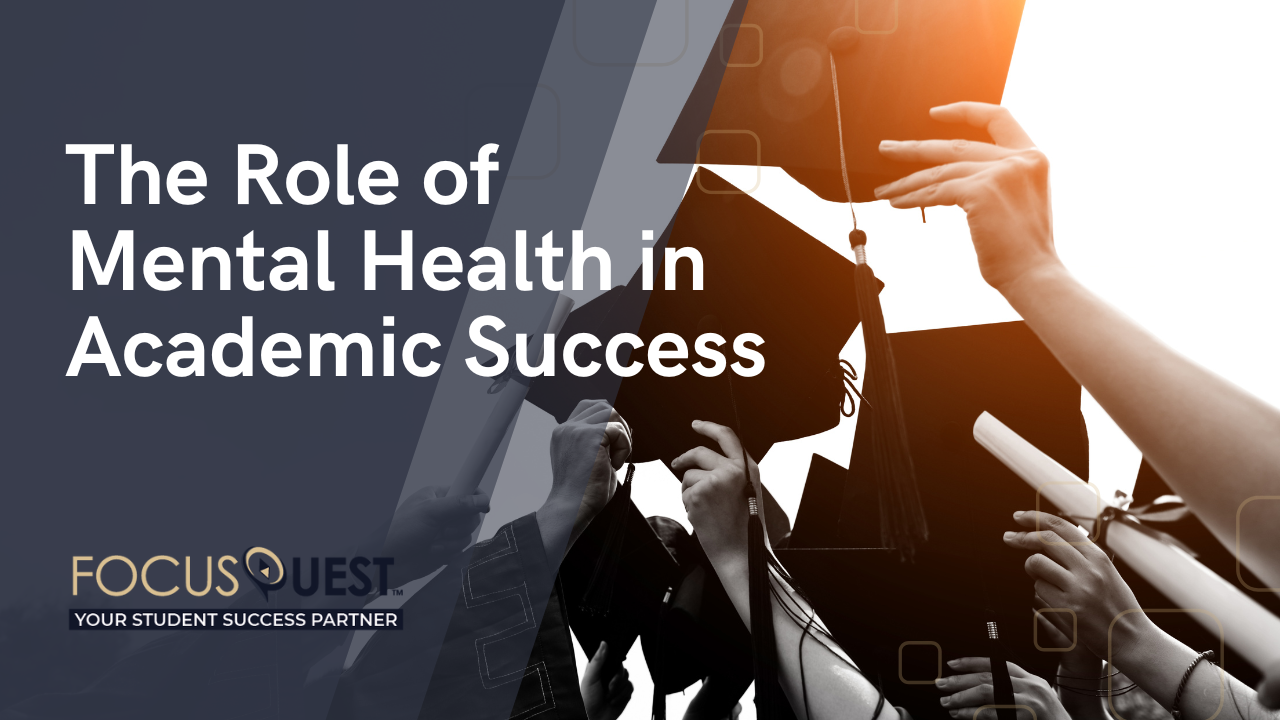
The Role of Mental Health in Academic Success

The Role of Mental Health in Academic Success

Share on Social Media

How emotional well-being shapes focus, motivation, and long-term achievement 

Mental health is one of the most powerful—yet often overlooked—factors influencing academic success. While strong study habits and effective time management matter, they are not enough on their own. Students perform best when their emotional well-being, stress levels, and sense of support are also prioritized. 

At FocusQuest, we view academic success as a whole-person journey. When students learn how to care for their mental health, they don’t just survive school—they thrive. 

Understanding the Connection Between Mental Health and Learning 

Mental health directly affects how the brain processes information. Stress, anxiety, and emotional fatigue can disrupt cognitive functions that are essential for academic performance, including: 

  • Attention and concentration 
  • Memory retention 
  • Problem-solving and decision-making 
  • Motivation and self-discipline 


When students feel overwhelmed or emotionally drained, even simple academic tasks can feel exhausting. Over time, unmanaged stress can lead to burnout, disengagement, and declining performance. 

Conversely, students who feel emotionally supported and mentally balanced are more likely to stay focused, persist through challenges, and maintain consistent academic progress. 

Common Mental Health Challenges Students Face 

Many students experience mental health challenges at some point in their academic journey. Some of the most common include: 

  • Academic stress and pressure from exams, deadlines, and expectations 
  • Anxiety related to performance, social situations, or uncertainty about the future 
  • Depression or emotional exhaustion, often linked to burnout 
  • Imposter syndrome, especially among first-generation or underrepresented students 


Recognizing these challenges early is a critical step toward addressing them in healthy, constructive ways. 

Stress Management Strategies That Support Academic Success 

Stress is unavoidable—but it can be managed. Developing healthy coping strategies allows students to stay productive without sacrificing their well-being. 

  1. Build a realistic routine

Creating a balanced schedule that includes study time, breaks, and rest helps reduce overwhelm. Overloading a schedule often leads to procrastination and increased anxiety. 

  1. Prioritize quality sleep

Sleep plays a vital role in learning and emotional regulation. Students who get enough rest perform better on exams, retain information more effectively, and manage stress more easily. 

  1. Practice intentional breaks

Short, intentional breaks improve focus and prevent mental fatigue. Stepping away from screens, stretching, or taking a brief walk can reset the mind. 

  1. Maintainhealthy habits 

Nutrition, hydration, and regular physical activity all contribute to emotional balance and mental clarity. 

Mindfulness Practices for Students 

Mindfulness is the practice of being fully present and aware without judgment. In an academic setting, mindfulness helps students manage stress, improve focus, and respond more calmly to challenges. 

Simple mindfulness practices students can use include: 

  • Deep breathing exercises before studying or exams 
  • Short daily meditation sessions 
  • Journaling to process thoughts and emotions 
  • Grounding techniques during moments of anxiety 


Research shows that mindfulness can improve concentration, emotional regulation, and resilience—skills that directly support academic success. 

The Importance of Seeking Support 

One of the most powerful steps a student can take is asking for help. Support systems provide perspective, guidance, and reassurance during difficult periods. 

Students can find support through: 

  • Campus counseling and mental health services 
  • Academic advisors or student success coaches 
  • Peer support groups and mentoring programs 
  • Trusted faculty members, friends, or family 


Seeking help early can prevent stress from escalating and helps students stay on track academically. 

Creating a Sustainable Path to Academic Success 

True academic success is not just about short-term results—it’s about sustainability. When students prioritize mental health, they develop lifelong skills such as emotional awareness, stress management, and self-advocacy. 

These skills don’t just support academic achievement; they prepare students for future challenges beyond the classroom. 

Put Mental Health at the Center of Your Academic Journey 

Academic success starts with mental well-being. At FocusQuest, we provide guidance, tools, and resources designed to help students stay focused, confident, and supported throughout their educational journey. 

👉 Explore FocusQuest programs and resources today to build habits that strengthen both your academic performance and your mental health. 


Frequently Asked Questions (FAQs) 

How does mental health affect academic performance? 

Mental health influences focus, memory, motivation, and emotional regulation. Poor mental health can make studying harder and reduce performance, while strong well-being supports consistent learning and engagement. 

What are early signs of academic burnout? 

Common signs include constant fatigue, lack of motivation, difficulty concentrating, irritability, and feeling emotionally detached from schoolwork. 

Can mindfulness really improve grades? 

Mindfulness improves attention, reduces stress, and enhances emotional control. These benefits often lead to better study efficiency and improved academic outcomes over time. 

When should a student seek mental health support? 

Students should seek support whenever stress, anxiety, or emotional challenges begin interfering with daily life or academic responsibilities—early intervention is key. 

How can students balance mental health and academic responsibilities? 

By creating realistic schedules, prioritizing rest, practicing stress-management techniques, and using available support resources consistently. 

facts corner

Featured Articles

_Article Thumbnail Templates FQ
The Role of Mental Health in Academic Success
Discover how peer support, study groups, and online communities can boost motivation, accountability,...
Read More
December 2025
Explore Other Issues December 2025 November 2025 October 2025 September 2025 August 2025 July 2025 June...
Read More
Categories
News Student Succes Coaching

New Year, New Possibilities!

Dear Students,

As Student Success Coaches, we would like to take this opportunity to reach out and communicate with you directly. We understand that your academic journey can be challenging, but please know that we are here to support you every step of the way.

We want to remind you that your success is our top priority. We are here to provide you with guidance, resources, and support to help you achieve your academic goals. Whether you need assistance with time management, study skills, or navigating the university, we are here to help.

It is important to remember that you are not alone in this journey. For this reason we have created this entry to provide you with a direct message and to be able to contact us more directly. We hope you enjoy.

Student Success Coaches

New Year, New Possibilities!

Share on Social Media

HAPPY NEW YEAR!

Welcome to 2026! Whether you’re starting your second semester or you’re already deep in your academic journey, this is YOUR year to level up!

Stay Locked In

As you dive into this new semester, remember: your goals are worth protecting. Don’t let distractions pull you off course. Think of this year as your main quest. You’re not just playing the game, you’re winning it. Every assignment completed, every class attended, every late-night study session? That’s XP (experience points) toward your degree. You’re not just earning credits… you’re unlocking your future.

Your Epic Adventure Awaits

Look at 2026 as one of the greatest adventures of your life! This is your Elden Ring journey, your Spider-Man: Miles Morales origin story, your Legend of Zelda quest to save your own kingdom. The challenges you face this year aren’t obstacles. They’re boss battles that make you stronger. And just like in your favorite game, you don’t give up when things get hard. You level up, you learn the patterns, and you come back even better.

You’ve Got This

To those of you starting fresh this semester: Welcome to the next chapter! Bring that New Year energy and let it carry you through.

To those of you in the thick of it: You’ve already proven you can do this. Keep that same energy. Stay focused. Stay motivated. Your finish line is closer than you think.

Here’s to a great and successful 2026! Let’s make this year legendary!

Now go out there and complete your quest!

Ndala M. Booker, Ed.D.

Chief Student Success Officer

More entries

Categories
Newsletter

December 2025

December 2025

Explore Other Issues

Categories
News Student Succes Coaching

Welcome to December… a month of endings, celebrations, and new beginnings.

Dear Students,

As Student Success Coaches, we would like to take this opportunity to reach out and communicate with you directly. We understand that your academic journey can be challenging, but please know that we are here to support you every step of the way.

We want to remind you that your success is our top priority. We are here to provide you with guidance, resources, and support to help you achieve your academic goals. Whether you need assistance with time management, study skills, or navigating the university, we are here to help.

It is important to remember that you are not alone in this journey. For this reason we have created this entry to provide you with a direct message and to be able to contact us more directly. We hope you enjoy.

Student Success Coaches

Welcome to December… a month of endings, celebrations, and new beginnings.

Share on Social Media

To Those Approaching Finals:

As you enter the final stretch of this semester, remember, you’ve come too far to let discouragement derail you now. Trust yourself. Trust the knowledge you’ve gained. Trust the hours you’ve invested in learning and growing. You are more prepared than you think. Finish strong. Notice I didn’t say “perfectly”, but authentically and with the confidence that you’ve done the work.

Celebrating December Graduates:

To those crossing the finish line this month… congratulations! Whether you’ve completed a degree, earned a certification, or finished a specialized program, FocusQuest celebrates this tremendous accomplishment with you. You’ve reached the end of this chapter, and we couldn’t be more thrilled to witness your success. This moment belongs to you. Celebrate it fully.

For Continuous Learners:

If you’re enrolled in programs without traditional semester breaks – those of you progressing through certifications, skills training, or year-round coursework – we see you too. Your journey doesn’t pause for December, and that’s okay. Keep your eyes on the destination, but don’t forget to appreciate where you are right now. Every module completed, every skill mastered, every challenge overcome is progress worth acknowledging.

Maya Angelou once said, “Success is liking yourself, liking what you do, and liking how you do it.” The journey itself, with all its struggles and victories, is where transformation happens. Don’t rush past it.

As the Year Closes:

Happy holidays to all who are celebrating! As 2025 comes to a close, take time to reflect on this year’s journey. Celebrate your successes:  the A’s earned, the concepts mastered, the obstacles overcome. But also honor what some might call “failures” or “setbacks.” Those moments taught you resilience, revealed your strength, and redirected you toward better paths. Viewed through the right lens, they’re successes too.

You’ve grown more than you realize. We’re proud to be part of your journey and excited to see what 2026 holds for you.

Here’s to finishing strong and starting fresh.

Dr. Ndala Booker
Chief Student Success Officer
FocusQuest, LLC

Ndala M. Booker, Ed.D.

Chief Student Success Officer

More entries

Categories
For School For Students

The Power of Peer Support: Finding Your Study Tribe

The Power of Peer Support: Finding Your Study Tribe

Share on Social Media

Why Peer Support Matters in Your Academic Journey 

You Don’t Have to Study Alone 

Whether you’re in a classroom, a dorm room, or learning remotely, one thing remains true: connection fuels success. Studying alone may feel productive, but over time it can lead to burnout, boredom, and isolation. That’s where peer support comes in—it offers encouragement, shared knowledge, and a sense of community. 

Social Learning and Mental Health Benefits 

Group learning improves memory and understanding. It also boosts your emotional well-being. Just knowing someone else is working alongside you can make a big difference—especially during stressful weeks or exam prep. 


What Is a “Study Tribe” and Why You Need One 

From Study Buddies to Success Networks 

Your study tribe is a small group of peers committed to helping each other succeed. They may be classmates, online learners, or even people in different time zones. What unites them is a shared mindset and mutual accountability. 

Shared Goals, Mutual Growth 

A good study tribe helps you: 

  • Stay focused 
  • Learn more deeply 
  • Share resources 
  • Celebrate progress together 


Benefits of Studying with Others 

Increased Motivation and Discipline 

When you know others are depending on you to show up, you’re more likely to stay consistent—even when motivation is low. 

Better Understanding Through Discussion 

Explaining concepts to others is one of the most effective learning methods. Study groups encourage questions, feedback, and collaborative problem-solving. 

Exposure to New Perspectives and Techniques 

Everyone has different ways of approaching material. Hearing different viewpoints can unlock your own understanding and introduce new study techniques. 


How to Form or Find a Study Group 

In-Person vs. Virtual Study Circles 

  • In-person: Great for local meetups, library sessions, or campus-based students 
  • Virtual: Perfect for remote learners, online classes, and global programs 

Tips for Starting Your Own Group 

  • Invite 2–5 people with similar academic goals 
  • Choose a regular meeting time 
  • Use platforms like Zoom, Discord, or WhatsApp for communication 
  • Set expectations early (focus, participation, sharing responsibilities) 


The Role of Accountability Partners in Academic Success 

What Makes a Good Accountability Partner 

An accountability partner is someone who: 

  • Reminds you of deadlines 
  • Checks in on your progress 
  • Celebrates your wins 
  • Gently nudges you when you procrastinate 

How to Stay on Track Without Pressure 

Set weekly or daily check-ins. Keep it casual but consistent. Share goals and track progress together without turning it into a competition. 


Leveraging Online Communities and Forums 

Reddit, Discord, Facebook, and Slack Groups 

There are countless digital communities where students can: 

  • Ask questions 
  • Share study resources 
  • Find encouragement 
  • Co-study with strangers turned friends 

Popular spaces include: 

  • r/college 
  • r/GetStudying 
  • Study Discord servers 
  • Facebook groups for student success or specific majors 

How to Find the Right Academic Community for You 

Search keywords like “study group,” “student support,” or your major plus “community.” Look for spaces with active members and respectful interactions. 


How to Make the Most of Study Sessions 

Set Clear Goals and Agendas 

Start each session by outlining what everyone hopes to achieve. Keep a shared agenda or checklist to stay focused. 

Use Study Methods Like Pomodoro or Feynman Together 

  • Pomodoro: 25-minute study sprints + 5-minute breaks 
  • Feynman Technique: Teach each other as if you’re explaining to a beginner 

Balance Focus with Fun 

Add light moments—like sharing a meme or a 2-minute stretch—to keep energy high and avoid burnout. 


Tools for Collaborative Studying 

Google Docs, Zoom, Notion, Miro 

These tools make it easy to: 

  • Take shared notes 
  • Brainstorm in real-time 
  • Organize group projects 
  • Host virtual study rooms 

facts corner

Featured Articles

_Article Thumbnail Templates FQ (2)
The Power of Peer Support: Finding Your Study Tribe
Discover how peer support, study groups, and online communities can boost motivation, accountability,...
Read More
November 2025
Explore Other Issues November 2025 October 2025 September 2025 August 2025 July 2025 June 2025 May 2025...
Read More
Categories
News Student Succes Coaching

Celebrating ALL Graduates

Dear Students,

As Student Success Coaches, we would like to take this opportunity to reach out and communicate with you directly. We understand that your academic journey can be challenging, but please know that we are here to support you every step of the way.

We want to remind you that your success is our top priority. We are here to provide you with guidance, resources, and support to help you achieve your academic goals. Whether you need assistance with time management, study skills, or navigating the university, we are here to help.

It is important to remember that you are not alone in this journey. For this reason we have created this entry to provide you with a direct message and to be able to contact us more directly. We hope you enjoy.

Student Success Coaches

Celebrating ALL Graduates

Share on Social Media

As autumn leaves paint our campuses with golden hues, I’m reminded how quickly this year has flown by. For some of you, this semester has been a whirlwind of accomplishments; for others, perhaps a mountain to climb. Wherever you find yourself, your journey matters.

Celebrating ALL Graduates

Today, I want to extend special congratulations to our online and certificate program graduates! While traditional May and December commencements get much attention, those completing nontraditional programs throughout the year deserve equal recognition.

Whether you’ve completed a healthcare certification, mastered data analytics, or earned credentials in another field – your achievement represents dedication, persistence, and growth. These accomplishments often come while balancing work, family, and life’s complexities, making them all the more impressive.

December Graduations Approaching!

For those preparing to walk across the stage in December, congratulations! After years of early mornings, late nights, and countless sacrifices, you’ve reached this milestone. Take time to reflect on your journey and celebrate this achievement you’ve worked so hard for.

On a personal note, I’m beaming with pride as my daughter Jae completes her Bachelor’s in Film Sciences from Full Sail University and graduates in just three weeks. The joy of watching our students (and yes, even our children) reach these milestones never diminishes!

Embrace Thanksgiving Break

If you’re continuing your studies, please hear this: Thanksgiving Break isn’t just a calendar notation. It’s a necessary pause. Academic burnout, senioritis, and mental exhaustion are real challenges that can threaten your persistence.

Use these precious days to genuinely disconnect and recharge. Put the textbooks aside. Close the laptop. Rest your mind. The research is clear: strategic breaks improve long-term performance and well-being. You’ll return with renewed focus and energy to finish the semester strong.

Gratitude in Action

As we approach Thanksgiving, I hope you’ll be surrounded by loved ones, good food, and moments that remind you what matters most. This season offers us all an opportunity to practice gratitude – not just as a feeling but as an action.

Consider taking a moment to thank those who’ve supported your educational journey: professors who challenged you, classmates who encouraged you, family members who believed in you, and perhaps most importantly, yourself for persevering.

Remember that the FocusQuest team is cheering for your success, celebrating your victories (big and small), and standing ready to support your continued growth.

Wishing you all a restorative Thanksgiving and a strong finish to the semester!

Ndala M. Booker, Ed.D.

Chief Student Success Officer

More entries

Categories
For School For Students

How to Turn Your Assignments Into Portfolio Pieces 

How to Turn Your Assignments Into Portfolio Pieces 

Share on Social Media

Why Portfolios Matter—Even Before You Graduate 

Portfolios as Proof of Skills 

In today’s competitive job market, employers want more than a résumé—they want evidence. A digital portfolio filled with your academic work shows what you can do, how you think, and what you’re capable of beyond grades. 

Standing Out in Internships and Job Applications 

When everyone has the same degree or GPA, what sets you apart? A portfolio shows you’ve applied classroom concepts to real-world problems—and that’s something employers notice. 

What Types of Assignments Make Great Portfolio Pieces? 

Research Papers and Essays 

If you’ve written a well-argued, well-researched paper on a topic relevant to your career field, it can absolutely serve as a portfolio piece—especially when summarized clearly. 

Design Projects and Presentations 

Slide decks, marketing plans, mock product designs, or architectural layouts are perfect for showing creativity and communication. 

Group Projects, Case Studies, and Labs 

Teamwork is a top soft skill. Projects like business cases, engineering prototypes, or scientific lab reports show problem-solving and collaboration. 

Capstone Projects or Final Year Work 

These are your most comprehensive, polished, and often most career-relevant pieces. Don’t let them collect digital dust—highlight them! 

Identifying Assignments With Portfolio Potential 

Look for Creativity, Depth, or Real-World Application 

Did the assignment solve a real problem, involve original research, or stretch your creativity? If yes—it belongs in your portfolio. 

Feedback from Professors as a Signal 

If a professor gave high praise or used your work as an example, that’s a strong indicator it’s portfolio-worthy. 

How to Polish an Assignment for Your Portfolio 

Editing, Formatting, and Presentation 

Before adding any project: 

  • Fix typos or formatting issues 
  • Update the layout for clarity 
  • Add headings or visuals if appropriate 
Removing School-Specific Jargon or Prompts 

Employers don’t need to see “COMS 401 Final Paper.” Instead, retitle it to something like: 

“Analysis of Crisis Communication Strategies in Social Media Campaigns” 

Converting to Employer-Friendly Formats 

Convert assignments to easy-to-view formats like: 

  • PDF for writing 
  • Slide decks for presentations 
  • Embedded links for web-based projects 

Add Context: Tell the Story Behind the Work 

What Was the Goal or Problem? 

Describe what the assignment was about—what problem did you solve, or what question did you explore? 

What Skills Did You Use or Develop? 

Mention tools, methods, or knowledge applied—Excel, Python, Canva, statistics, persuasive writing, etc. 

What Was the Outcome or Learning? 

Even if the result wasn’t perfect, show what you learned. Employers value growth mindset as much as results. 

Tools to Create a Digital Portfolio 

Notion, Wix, Google Sites, and WordPress 

These free or low-cost tools are easy to use and great for creating student portfolios without needing coding skills. 

GitHub for Developers and Designers 

For coding, data, or technical design, GitHub repositories show both your work and your version control skills. 

Behance or Dribbble for Visual Creators 

For those in graphic design, photography, or UI/UX—these platforms are industry standards. 

Organizing Your Portfolio for Maximum Impact 

Grouping by Skills or Categories 

Divide projects into sections like “Writing,” “Data Analysis,” or “Team Projects” to help employers find what they need. 

Highlighting Projects With Results or Creativity 

Use thumbnails or icons to spotlight standout work. First impressions count! 

Adding Short Descriptions and Visuals 

Every piece should include: 

  • A title 
  • A 2–3 sentence summary 
  • Visuals if applicable 
  • A skills or tools tag (e.g., “Python,” “Public Speaking”) 

Showcasing Soft Skills Through Academic Work 

Problem-Solving, Teamwork, Research, Communication 

Don’t just show what you did—show how. Include notes about how you handled conflict in a group, or how you adapted when your original plan didn’t work. 

Turning Group Assignments Into Individual Portfolio Pieces 

Clarifying Your Role and Contributions 

Explain clearly what you did: 

“In a team of four, I was responsible for market research, designing customer personas, and leading the presentation.” 

Getting Permission to Share Work 

Ask teammates or professors if they’re comfortable with you sharing group work—especially if it includes their names or content. 

Privacy and Academic Integrity Considerations 

Removing Grades or Peer Information 

Never post your grades. Also, remove classmates’ names or any identifying information unless you have consent. 

Citing Sources Properly 

Keep citations intact to show academic honesty—and your attention to detail. 


How to Talk About Portfolio Work in Interviews 

Use the STAR Method (Situation, Task, Action, Result) 

Tell the story of your project using: 

  • Situation: What was the context? 
  • Task: What were you responsible for? 
  • Action: What did you do? 
  • Result: What did you achieve or learn? 
Connect Projects to the Role You’re Applying For 

Tailor your talking points to show how your schoolwork prepared you for the responsibilities of the role. 

Linking Assignments to In-Demand Skills and Career Goals 

Aligning with Job Descriptions or Career Paths 

If the job mentions “data visualization,” showcase your Excel dashboards or Tableau projects. Align your portfolio with your goals. 

Keywords That Employers Look For 

Include terms like: 

  • “Project management” 
  • “UX design” 
  • “Technical writing” 
  • “Data analysis” 

This helps with applicant tracking systems and shows relevance. 

Real Student Examples: Portfolios That Got Noticed 

Success Stories from STEM, Business, and Arts Students 
  • Business Student: Used a marketing class campaign project in a portfolio and landed an internship at a local agency. 
  • Engineering Student: Showcased a prototype from a group capstone and now works in R&D. 
  • Design Student: Created a public Google Site featuring classwork and freelance designs, leading to their first client. 

FAQs: Student Portfolios and Academic Work 

  1. Can I include unfinished assignments?
    Yes—just note that it’s a “work in progress” and explain where you’re going with it. 
  1. How many portfolio pieces do I need?
    Aim for 3 to 5 strong pieces to start. Quality always beats quantity. 
  1. What if my assignments aren’t visually impressive?
    That’s okay! Good writing, critical thinking, and creativity matter too. Add a compelling explanation. 
  1. Should I update my portfolio every semester?
    Yes. Make it a habit to review and refresh your portfolio at the end of each term. 
  1. How do I protect my work from being copied?
    Use watermarks, low-res previews, or restrict downloads. You can also include copyright disclaimers. 
  1. What’s the best way to share my portfolio with employers?
    Include a link on your résumé, LinkedIn, and email signature. If it’s private, send it as a PDF upon request. 


Final Thoughts: Your Degree Is Only Part of the Story—Your Work Speaks Louder 

Turning assignments into portfolio pieces is one of the most strategic moves you can make as a student. It shows that you’re proactive, self-aware, and already thinking like a professional. 

Don’t wait until you’re job hunting to start. Build your portfolio as you go—piece by piece. You’ll gain confidence, direction, and a major advantage in whatever comes next. 

facts corner

Featured Articles

_Article Thumbnail Templates FQ (1)
How to Turn Your Assignments Into Portfolio Pieces 
Learn how to turn your school assignments into professional portfolio pieces that impress employers....
Read More
October 2025
Explore Other Issues October 2025 September 2025 August 2025 July 2025 June 2025 May 2025 April 2025...
Read More
Categories
News Student Succes Coaching

Finding Your Rhythm This Fall

Dear Students,

As Student Success Coaches, we would like to take this opportunity to reach out and communicate with you directly. We understand that your academic journey can be challenging, but please know that we are here to support you every step of the way.

We want to remind you that your success is our top priority. We are here to provide you with guidance, resources, and support to help you achieve your academic goals. Whether you need assistance with time management, study skills, or navigating the university, we are here to help.

It is important to remember that you are not alone in this journey. For this reason we have created this entry to provide you with a direct message and to be able to contact us more directly. We hope you enjoy.

Student Success Coaches

Finding Your Rhythm This Fall

Share on Social Media

We’re deep into the semester now, and I want to check in with you. How are you doing? Really doing?

By mid-October, the initial excitement of the fall semester has settled into the steady rhythm of assignments, projects, and preparing for midterms. This is when I often hear from students who feel overwhelmed or exhausted. If that’s you, I need you to know that you’re not alone—and that this feeling doesn’t define your entire semester.

Success Starts in Your Mind

Here’s something I want you to remember: Success begins with a decision. It starts in your mind before it shows up anywhere else. When you decide—truly decide—that you’re going to succeed, that choice influences every decision that follows. Do you study tonight or scroll social media, or manage your time effectively and do both? Do you reach out for help or struggle alone? Do you show up to class or hit snooze? Each choice builds on that original decision to succeed.

Permission to Breathe

But here’s the other truth: sustainable success requires rest. This weekend, I’m giving you permission—actually, I’m encouraging you—to step away from your desk and go to a fall festival. Take a walk through fallen leaves. Grab a pumpkin spice something. (Everyone has them now) Breathe deeply and remind yourself why you’re doing this work in the first place.

Success without rest isn’t sustainable. You’re not a machine. You’re a human being pursuing meaningful goals, and that requires both effort and restoration.

Refreshing Your Tools

Think about the study skills and strategies you learned at the beginning of the semester. Are you still using them? Or have old habits crept back in? There’s no shame in needing a refresher. Actually, recognizing when you need to sharpen your tools shows maturity and self-awareness.

If you’re feeling rusty on time management, note-taking, or test preparation strategies, take an hour this week to revisit those skills. Sometimes we just need to get back to basics.

Stay Connected

We share practical student success tips regularly on our Instagram—quick, actionable advice you can implement immediately. Follow us there for ongoing support throughout your academic journey.

Remember: You’ve already made it this far into the semester. That took commitment, resilience, and strength. Keep going. Take breaks when you need them. Ask for help when you need it. And trust that the decision you made to succeed will continue guiding you toward your goals.


You’ve got this!

Ndala M. Booker, Ed.D.

Chief Student Success Officer

More entries

Categories
For School For Students

How to Balance Work, Study, and Life as an Adult Learner 

How to Balance Work, Study, and Life as an Adult Learner 

Share on Social Media

The Challenge of Balance for Adult Learners 

What Makes Adult Learning Unique 

Adult learners are not traditional college students. You’re likely managing a full-time job, family obligations, or even community responsibilities, all while pursuing a degree or certification. Unlike younger students, your time and energy are constantly divided between critical roles. 

The Realities of Juggling Multiple Roles 

Every hour matters when you’re an adult learner. You might go from a 9-to-5 shift to a night class or wake up early to study before preparing the kids for school. This life rhythm is complex—but with the right strategies, it becomes manageable. 


Mindset Shift: From Overwhelm to Empowerment 

Accepting the Non-Linear Journey 

Progress won’t always be perfect. Some weeks will be harder than others. Recognizing that setbacks are normal—and that your journey is valid—is the first step toward sustainability. 

Redefining Success in Your Own Terms 

Forget comparisons. Success isn’t a GPA; it’s being consistent, resilient, and intentional with your time. Adult learners often outperform traditional students in motivation and grit, even if the path is less linear. 


Master Time Management 

Use a Weekly Schedule Template 

Start with a simple calendar. Block out work hours, class times, study blocks, family time, and rest. A visual layout helps you identify gaps and create structure. 

Time-Blocking for Deep Focus 

Dedicate specific hours to focus-heavy tasks like studying. For example, set 6–8 p.m. on Tuesdays and Thursdays as sacred study time—no distractions allowed. 

Plan Rest as Rigorously as Work 

Overworking leads to burnout. Intentionally plan downtime. Use short breaks between tasks and aim for at least one rest day per week. 

📌 Tip: Treat study time like a non-negotiable appointment. 


Use Productivity Apps to Stay on Track 

Task Management with Trello or Asana 

Use boards or lists to organize assignments, deadlines, and personal goals. Break big tasks into smaller, actionable steps. 

Scheduling with Google Calendar 

Sync all your commitments—work, school, life—in one place. Use color coding to distinguish between task types. 

Staying Focused with Forest or Focus@Will 

  • Forest: Encourages focus by growing a virtual tree as you study. 
  • Focus@Will: Provides music scientifically designed to boost concentration. 


Learn to Prioritize What Truly Matters 

The Eisenhower Matrix Explained 

Use this tool to sort tasks into four categories: 

Urgent & Important 

Do it now 

Important but Not Urgent 

Schedule it 

Urgent but Not Important 

Delegate it 

Neither 

Eliminate it 

Progress Over Perfection 

Some weeks, finishing 80% of your study plan is a win. Don’t aim for perfection—aim for momentum. 

The Power of Saying No 

Learn to decline social events or extra projects that don’t align with your goals. Your time is valuable. 


Build a Reliable Support System 

Talking to Employers and Professors 

Let them know you’re an adult learner. Many are willing to accommodate flexible deadlines or work shifts when you’re transparent about your goals. 

Involving Family in Your Journey 

Set expectations at home. Whether it’s your partner, children, or roommates, involve them in your schedule so they understand and respect your study time. 

Connect with Fellow Adult Learners 

Build a network. Join online forums, peer support groups, or community study sessions. Accountability and encouragement go a long way. 


Protect Your Physical and Mental Well-Being 

Prioritize Sleep, Nutrition, and Movement 

No degree is worth sacrificing your health. Strive for 7–8 hours of sleep, eat balanced meals, and aim for at least 15–30 minutes of movement each day. 

Daily Mindfulness or Reflection 

Start or end the day with five minutes of stillness, journaling, or breathing. It can reduce stress and improve focus. 

Celebrate Small Milestones 

Finished a module? Submitted a paper? Celebrate! These moments build confidence and motivation. 


Manage Energy, Not Just Time 

Recognizing Your Productivity Peaks 

Some people work best early in the morning; others find focus after dark. Identify your high-energy hours and align your most demanding tasks with them. 

Matching Tasks to Energy Levels 

Do simple or repetitive tasks during low-energy periods. Save deep learning or writing sessions for when you feel most alert. 


Financial and Academic Planning Tips 

Budgeting Time and Money Wisely 

Use financial planning tools or consult advisors to manage tuition, books, and other costs. Apply for scholarships—many are tailored for adult students. 

Applying for Scholarships and Aid 

Look for grants from your institution or government programs that support returning students or working parents. 


Study Smarter, Not Harder 

Use Active Recall and Spaced Repetition 

These science-backed techniques help with long-term retention. Test yourself often and revisit material over time instead of cramming. 

Optimize Note-Taking and Study Sessions 

Use structured methods like the Cornell Note System or apps like Notion and Anki to enhance learning efficiency. 


Avoiding Burnout and Overload 

Spot the Warning Signs Early 

Feeling constantly tired, frustrated, or demotivated? These are signs of burnout. Pause and adjust your approach before it gets worse. 

Adjusting Commitments When Necessary 

It’s okay to drop a class, reduce work hours, or delegate tasks. Flexibility is key to longevity. 


Real-Life Success Stories of Adult Learners 

How Working Parents Earned Their Degrees 

Maria, a single mom, completed her associate degree while working evenings. She credits her success to scheduled “power study hours” at 5 a.m. before her kids woke up. 

Student Testimonials from FocusQuest 

Students supported by FocusQuest report feeling more confident and organized, thanks to personalized coaching and structured planning tools. 


How FocusQuest Helps Adult Learners Succeed 

Support Coaching and Online Flexibility 

FocusQuest provides adult learners with one-on-one support, flexible online learning, and time-management strategies tailored to real-life situations. 

Real Tools for Real Students 

From productivity tools to success coaching, FocusQuest equips learners to manage stress, meet goals, and build confidence every step of the way. 


FAQs About Balancing Work, Study, and Life 

  1. Can I go back to school while working full-time?

Yes! Many adult learners do. You’ll need a flexible schedule, strong support, and clear priorities—but it’s absolutely doable. 

  1. How many hours a week should I study?

Aim for 10–20 hours, depending on your course load. Break it into manageable daily sessions. 

  1. How do I explain my needs to my employer or family?

Be honest and specific. Share your goals, timelines, and the kind of support you need—like flexibility or quiet time. 

  1. What if I fall behind on schoolwork?

Reach out to professors early. Most are willing to help if they know you’re committed and proactive. 

  1. What are the best tools for staying organized?

Trello, Google Calendar, Notion, and Anki are great for managing tasks, notes, and study routines. 

  1. How can FocusQuest help me?

FocusQuest offers student success coaching, flexible online tools, and tailored support designed specifically for adult learners balancing multiple responsibilities. 


Final Thoughts: You Can Do This—with the Right Strategy and Support 

Balancing work, school, and life is a real challenge—but it’s not impossible. With structure, support, and self-awareness, you can thrive as an adult learner. 

Remember: It’s not about doing everything—it’s about doing the right things, consistently. Stay focused, ask for help, and take pride in every step forward. 

👉 At FocusQuest, we believe in your success. Whether you’re returning to school after years or balancing family life with study, we’re here to help you keep going—stronger and smarter. 

facts corner

Featured Articles

_Article Thumbnail Templates FQ (2)
Networking 101: How Students Can Build Meaningful Career Connections Online
Learn the secrets of digital networking with this student guide. From LinkedIn strategies to virtual...
Read More
_Article Thumbnail Templates FQ (3)
How to Balance Work, Study, and Life as an Adult Learner 
Learn how to study smarter, not harder, with science-backed techniques like active recall, spaced repetition,...
Read More
Categories
News Student Succes Coaching

Your Education is Your Superpower

Dear Students,

As Student Success Coaches, we would like to take this opportunity to reach out and communicate with you directly. We understand that your academic journey can be challenging, but please know that we are here to support you every step of the way.

We want to remind you that your success is our top priority. We are here to provide you with guidance, resources, and support to help you achieve your academic goals. Whether you need assistance with time management, study skills, or navigating the university, we are here to help.

It is important to remember that you are not alone in this journey. For this reason we have created this entry to provide you with a direct message and to be able to contact us more directly. We hope you enjoy.

Student Success Coaches

Your Education is Your Superpower

Share on Social Media

Your presence in these halls of learning represents courage, ambition, and the promise of tomorrow. The decisions you make today about your education, the habits you develop, and the relationships you build are investments in a future that extends beyond your individual success to encompass the communities you will serve and the positive change you will create.

Let me be straight with you about something: your education is way more powerful than you might realize right now.

Sure, you’re here to get your degree and land a great job, but its more than that! What’s really happening is that your brain is getting a complete upgrade. Every challenging class and late-night study session is building your ability to tackle problems you haven’t even imagined yet.

The facts you’re memorizing today might be outdated in ten years, but learning how to think through complex problems? That skill never goes out of style.

Here’s what critical thinking really looks like: asking “What evidence backs this up?” when someone makes a claim, looking at problems from multiple angles, and being comfortable saying “I don’t know, but let me find out.”

In every class, practice asking yourself: Does this make sense? Are there other ways to look at this? These aren’t just academic exercises—they’re training for real life. The professionals who stand out aren’t just technically competent—they’re the ones who can analyze situations clearly and make smart decisions.

Let’s talk a little bit about Emotional Intelligence. College is like a laboratory for developing people skills. That frustrating group project? You’re learning project management and conflict resolution. The difficult roommate situation? You’re developing communication skills. The challenging professor? You’re building adaptability.

Pay attention to these experiences. Notice how you handle stress or criticism. Watch how your words affect others. The professionals who excel in their fields connect with people, manage emotions under pressure, and build strong working relationships.

Embrace the Challenge

College is supposed to be challenging. When you’re struggling with difficult concepts, that’s not a sign you don’t belong here—that’s your brain growing. Don’t just aim to survive your classes—dive in. Ask questions. Go to office hours. The more actively you engage, the more you’ll get out of it.

Your education isn’t just about you. There is a ripple effect that happens when you educate yourself. Every skill you develop strengthens your entire community. When you succeed, you create pathways for others. The communities that supported you getting here deserve your best effort, and the communities you’ll serve are counting on you to bring both competence and character to your work.

As you move forward, remember that your journey through higher education is preparing you for more than a career—it’s preparing you for leadership and making a difference in the world. Make this year count. Your community is cheering for you.

Dr. Ndala Booker
Chief Student Success Officer
FocusQuest

Ndala M. Booker, Ed.D.

Chief Student Success Officer

More entries